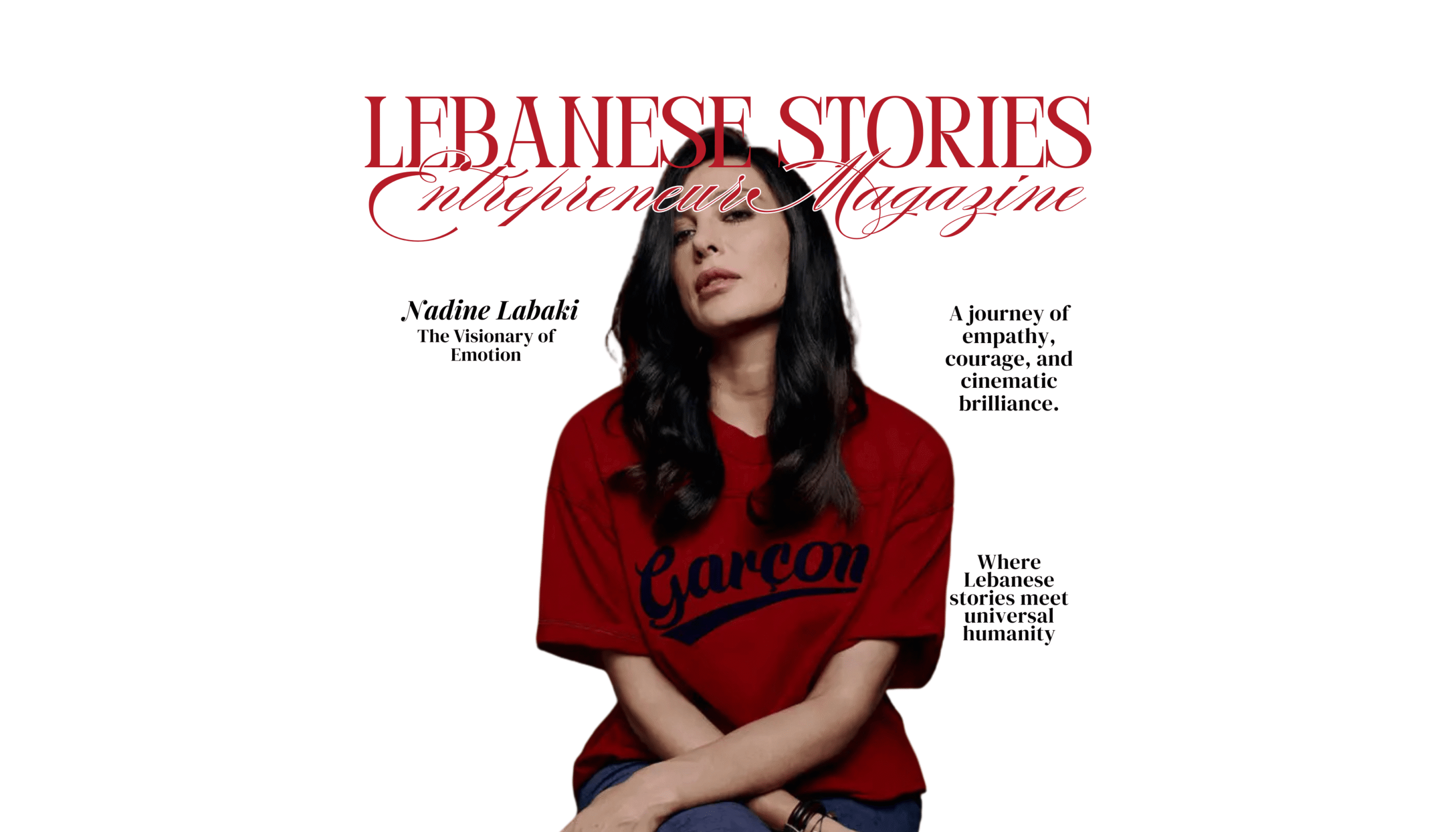
The Lebanese filmmaker who turned emotion into revolution.
Few artists have captured the soul of Lebanon as profoundly as Nadine Labaki. Actress, writer, and director — she is a storyteller whose work transcends cinema. With every frame, every line, and every tear, she transforms the pain and poetry of Lebanese life into something eternal.
Nadine Labaki is not just a filmmaker; she is a movement. A woman who gave voice to the unheard, dignity to the forgotten, and visibility to the unseen. Her art is not about escape — it’s about truth.
A Woman from Lebanon with a Camera and a Vision
Born in Baabdat in 1974, Nadine grew up during the Lebanese civil war — a reality that quietly shaped her worldview. Amid chaos and loss, she developed a fascination with people, with their stories, with emotion itself.
After studying audiovisual arts at Saint Joseph University in Beirut, she began directing music videos in the late 1990s. Her work was vibrant, raw, and deeply Lebanese — colorful like our culture, emotional like our people.
But behind the glamour of early fame, Nadine was quietly preparing for something far greater: a cinematic revolution born out of empathy.
Caramel — A New Face of Lebanon
In 2007, Nadine wrote, directed, and starred in Caramel — her debut feature film.
Set in a Beirut beauty salon, the film told the stories of five women navigating love, aging, religion, and identity. There were no war scenes, no politics — only humanity. And that was revolutionary.
The film premiered at the Cannes Film Festival and became an international sensation, breaking stereotypes about Lebanon and the Arab world. Nadine gave audiences something they had never seen before: Lebanese women not as victims, but as complex, beautiful, flawed, and free.
Caramel was not only a success; it was a statement. It proved that Lebanon had stories worth telling — and that women could be the ones telling them.
Where Do We Go Now? — The Power of Peace through Art
Her second film, Where Do We Go Now? (2011), cemented her as a visionary. The story of a Lebanese village where women unite to prevent religious conflict, the film balanced humor, heartbreak, and hope in perfect harmony.
It won the People’s Choice Award at the Toronto International Film Festival and was Lebanon’s official Oscar entry.
Through laughter and pain, Nadine reminded the world that art can be an act of peace — that sometimes, it takes a woman’s voice to heal what men’s wars destroy.
Capharnaüm — Humanity on the Edge
Then came Capharnaüm (2018) — a film that would forever define her career.
Telling the story of a 12-year-old boy, Zain, who sues his parents for bringing him into a world of poverty and neglect, the movie tore through hearts across continents. It wasn’t fiction — it was Lebanon, raw and real.
Shot with non-professional actors, Capharnaüm blurred the line between art and reality. Nadine’s direction was fearless — stripped of artifice, rich in empathy. The film premiered at Cannes, received a 15-minute standing ovation, won the Jury Prize, and was nominated for an Oscar for Best Foreign Language Film.
But beyond awards, it became a mirror to humanity — reflecting a Lebanon that struggles, survives, and still dares to hope.
A Voice Beyond Cinema
Nadine’s power goes beyond filmmaking. She is an activist in her own right — advocating for women’s rights, social justice, and refugee visibility. She speaks softly, but her message carries thunder.
In every interview, she returns to one theme: responsibility.
“The artist,” she says, “is responsible for making people feel again — for turning chaos into understanding.”
Her humility, intelligence, and grace make her one of Lebanon’s most admired public figures. She carries herself with the quiet confidence of someone who knows her work will outlive her — because it already speaks for generations.
Lebanon Through Her Lens
What makes Nadine Labaki’s work uniquely Lebanese is its heart.
She captures the contradictions — beauty and chaos, humor and heartbreak, fragility and strength — the essence of a nation that refuses to die.
Through her eyes, Lebanon becomes both a wound and a poem.
Her films are visual love letters to her country — honest, unfiltered, and filled with longing. Even when she exposes Lebanon’s pain, it’s done with tenderness, not despair.
Nadine doesn’t glorify Lebanon — she humanizes it.
A Legacy Written in Emotion
Today, Nadine Labaki stands as one of the Arab world’s greatest storytellers. Her name sits beside global auteurs, yet her soul remains deeply Lebanese.
She continues to mentor young filmmakers, speak at international conferences, and champion causes that matter. Each project she undertakes carries the same DNA — truth, empathy, and courage.
Her journey is proof that one camera, one idea, and one woman’s conviction can change how the world sees an entire nation.
Nadine Labaki didn’t just make films — she gave Lebanon a cinematic identity.
 lebanesestories.com